
Conference registration

The IST-26 Organizing committee thanks the transitions research community for the exceptional response to the call for abstracts. We received over 1000 submissions across 17 conference tracks and 7 proposed thematic sessions, signalling extraordinary interest in transitions research. At the same time, selecting the most relevant research themes and presentations has been very challenging, both for the organizing committee and for track/session convenors. We are now pleased to announce that the conference program will include more than 550 full paper presentations, speed talks, posters and special sessions.

Registration is now open for presenting authors, panellists, track convenors and special session organizers. Due to limited capacity, we strongly recommend thatpresenting authors, panellists, track convenors and special session organizers register as soon as possible. Registration for non-presenting participants will open on June 19.


Key dates

22 May 2026 – Early-bird registration opens for presenting authors, track convenors, special session organizers and panellists.

19 June, 23:59 CEST – Early bird registration closes. Registration opens to everyone.

26 June, 23:59 CEST  – Deadline for presenting authors: Completing registration and uploading full papers. Uploading a full paper is mandatory for full paper presentations, and optional for speed talks.

24 July, 23:59 CEST  – Registration closes for all. 

2 August, 23:59 CEST – Paper submission deadline for participants of the paper development workshop. 


Assistance for visa applications

Participants requiring letters of invitations or other assistance for visa application processes are requested to write to us as soon as possible. Application procedures for Switzerland can take as long as three months.

Conference fees
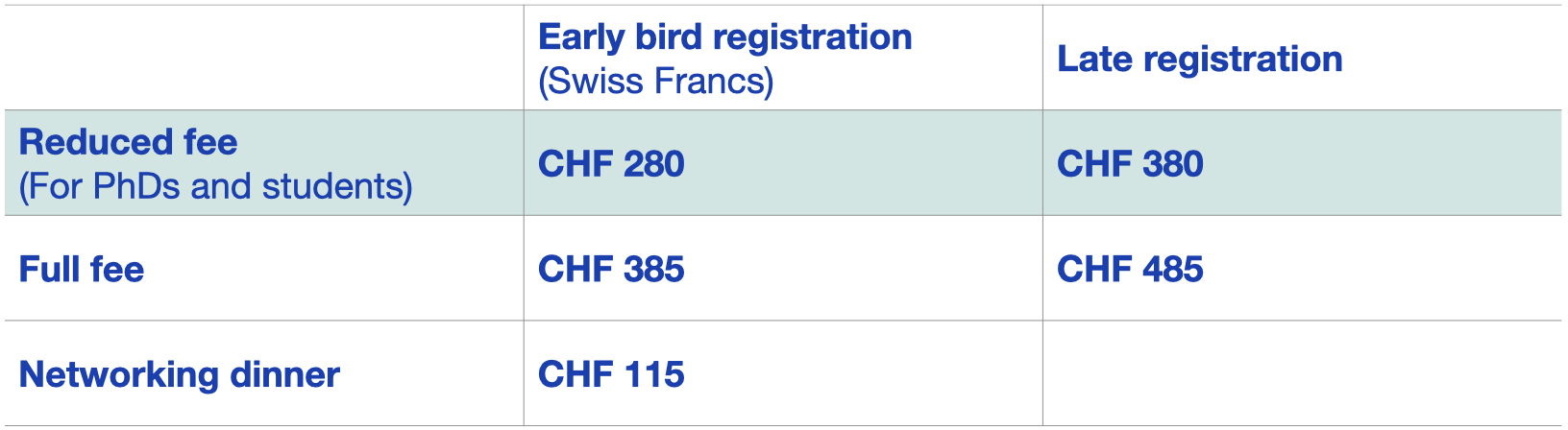
Conference fee refund policy
Withdrawals of registrations, if communicated to the organizing committee by the 10th of July, will result in full refunding. Requests received after that date cannot be considered anymore. These rules also apply to dinner tickets. In special cases of participants suffering from medical emergencies, or those not receiving travel visas in time, a full reimbursement will still be provided, irrespective of the date of withdrawal. In such cases, please send us documentation of the reasons for withdrawal like visa rejections.

Program overview

Accessibility: Please note that all venues of the conference and the dinner venue are accessible for wheelchair users.

Information on key conference events

Plenaries

31 August: Plenary session on ‘Hope’
Moderator: Christian Binz
Presenter: Simon Sharpe
Panellists: Huiwen Gong, Wisdom Kanda

1 September: Plenary session on ‘Impact’
Moderator: Alejandro Nuñez-Jimenez
Panellists: Marko Hekkert, Veena Srinivasan

More information on the plenaries will be announced soon.

Semi-plenaries

Semi-plenaries are organized as parallel sessions between 11-12:00 on the 2nd of September. During registration, participants are expected to tentatively choose the session they would like to attend. This is to help the organizing team allocate seminar rooms with sufficient capacity.

Semi-plenary 1: Bridging post-growth and transitions perspectives

Transitions scholars base their hope on (technological) innovations in shaping more sustainable socio-technical systems. These innovations tend to be developed and diffused through established, growth-oriented economic structures. Postgrowth scholars, in contrast, shift the spotlight to achieving human well-being within ecological boundaries. They criticize the established logic of growth-oriented industries and organizations. The plenary aims to foster exchange and synergies between the two research fields and to enrich transitions thinking towards socio-technical systems that reduce resource dependencies and social inequalities.

Moderator: Koen Frenken
Panellists: Adrian Smith, Vasilis Kostakis, Julia Steinberger

Semi-plenary 2: Towards a new theory of scaling dynamics?

This semi-plenary assembles a panel of scholars that have addressed innovation scaling phenomena from different – and complementary – theoretical perspectives (sociology, organization studies, human geography and political sciences). The session will first provide an overview of potential key building blocks of a renewed theory on innovation scaling and then try to distill promising research directions in an engaged debate between our panelists and the audience.

Moderators: Christian Binz, Wouter Boon, Amanda Bankel
Panellists: Lea Fuenfschilling, Francesca Ciulli, Johan Miorner, James Meadowcroft

Semi-plenary 3: Escaping the complexity trap

Transition scholars have long argued that sustainability transitions are inherently complex, calling for nuanced policies that reflect this complexity. Policymakers introduced new and ever more complex policies. However, this has created a “complexity trap” many actors find hard to navigate. To escape it, this semi-plenary invites transition scholars to engage with political scientists and policy practitioners. Featuring prominent figures from each community, it aims to launch a dialogue and open new research directions toward understanding how complexity shapes transitions and influences policies.

Moderators: Meike Löhr and Alejandro Nuñez-Jimenez
Panellists: Florence Metz, Karoline Rogge, Andris Piebalgs,

Semi-plenary 4: Interrogating justice in ‘just transitions’

The notion of ‘just transitions’ aims to reconcile environmental and social concerns in the movement towards sustainable futures. While the idea of transition implies dynamism and change, prevailing scholarship often treats justice as a fixed, universal ideal. Yet, if sustainability transitions involve change, isn’t it to be expected – and accepted – that the idea of justice itself change, too? What are the analytical and practical advantages and the risks of dynamic and context-specific understandings of justice in ‘just transitions’? This plenary aims to explore this question and discuss important directions for future research on ‘just transitions’.

Moderator: Giuseppe Feola.
Panellists: Ping Huang, Mónica Ramos Mejía, Fulvio Castellacci.

Conference dinner and party

Due to limited capacity, tickets for the conference dinner will be served on a first come first serve basis. Participants are requested to register as soon as possible.

The post-dinner party is open to all!

Dinner and party venue: https://kraftwerk.zuerich/

Boat cruise or city excursions

On the 1st of September, join us in exploring Zurich on an hour-long boat cruise or through thematic guided tours. During registration, participants can choose from four different options for the guided tours:

  1. Old Town of Zurich
  2. Archaeology in Zurich
  3. Water in Zurich
  4. Zurich’s powerful women

Because slots for the tours are limited, there is a fee of 5.- CHF. All tours start at the conference venue and end at the dinner venue. For more information, please visit:
https://www.zuerich.com/en/sightseeing-activities/guided-tours-and-walks/guided-tours

Early career researchers and newcomers (PhD students + Post-Docs within 3 years after completion of PhD) are warmly invited to join the Welcome Day on Sunday, 30 August. The event brings together young researchers working on sustainability transitions, providing a space to connect and exchange ideas before the main conference.

The local organizing committee and NEST have put together a program to spark discussion around the day’s theme: Being a Transitions Researcher – Building Careers that Keep Ourselves Hopeful

The ECR Welcome Day will take place at the ETZ building of ETH Zürich (Gloriastrasse 35, 8092 Zürich). You can sign up for the event when registering for the conference.

Please note that participation is limited to ECRs as there is a limited capacity of 180 participants.

Main events for the day:

  • 13:00-13:30 Welcome note
  • 13:30-14:30 Keynote on ‘Trust in Science – How advocacy affects public trust in scientists’ by Viktoria Cologna from Eawag
  • 15:00-17:00 Group discussions moderated by transition scholars 
    See below for the four parallel discussion sessions:

Group discussion 1:
Between expectations and reality: navigating emerging tensions in academic life through unlearning

Laura van Oers & Jonathan Friedrich

Early career researchers in sustainability transitions often enter the field with strong expectations about impact, interdisciplinarity, care etc. Over time, these expectations may collide with the realities of academic work, producing friction, tension, and moments of uncertainty. This session invites participants to explore these tensions through the lens of unlearning: letting go of taken for granted assumptions, habits, or aspirations to navigate academic life differently. Can unlearning be a practical strategy for navigating academic life, a conceptual way of making sense of it, or both?


Group discussion 2:
How dare you? Asking questions that keep us awake at night.

Kristina Bogner & Jonas Torrens

We live in a world that is saturated with questions for which we already have answers. Dominant research approaches discipline us to formulate „research questions“ that are „answerable“ and „feasible“. But what about the bold, daring, or disturbing questions that keep us awake at night? In this session, we will explore what truly motivates and anchors our inquiry. We will go beyond asking traditional research questions to explore the disturbances and longings that mobilise us. This session will help you connect with that which brings you aliveness and courage.

Group discussion 3:
Evolving with the world: Relational researchers charting the course towards hopeful realities

Merin Jacob & Alboricah Rathupetsane

What does it mean to be an academic navigating the in-between spaces?

To drive impact in the real world requires knowing how to show up in different spaces with diverse stakeholders. From connecting with young entrepreneurs and artists, to addressing homelessness in one of the wealthiest towns in South Africa, to shaping policy negotiations with industrialists and policymakers – it’s only Just if it’s collective.

All of this requires you to show up in society.

Join us in conversation around ways of enacting hope as an academic:

  • Positionality – who you are and where you stand matters
  • Individual Agency – navigating spaces and power
  • Activism in scholarship – experimenting with radical incrementalism
  • Building relationships for change through TD and embedded research
  • Dealing with the human – rage as a fuel for more just futures

Group discussion 4:
Developing a new research theme: Lessons from the thematic group on Multi-System Dynamics
Meike Löhr & Ksenia Onufrey

How does a new research topic take shape — and what does it actually take to build a community around it?

This session invites ECRs who are curious about the process of how a new topic in transitions research can emerge and grow. Using Multi-System Dynamics as an example, we will share our experiences about building a thematic group and related activities – from organising IST tracks and annual workshops to a journal special issue. Together, we will reflect on opportunities and challenges in working within a new transitions topic: navigating between old and new concepts, building legitimacy for new ideas, and knowledge. In addition, we will discuss practical aspects of building a research community, including how arenas like IST can be used to initiate collaborations, organise activities and shape research agendas.

The session combines inputs from MSD thematic group organisers with interactive discussions generating insights on:

  • How MSD developed and what lessons we have learned on the way
  • Challenges of publishing and positioning work in an emerging area
  • How ECRs can actively contribute to building new research topics and communities

Group discussion 5:
Seeing transformation differently: Interdisciplinary lenses for early-career researchers
Henrik Larsen & Vitaliy Soloviy

Sustainability transitions is a highly interdisciplinary field, but how can early-career researchers also benefit from rapidly evolving broader knowledge on transformative change? This interactive session introduces a practical six-lens framework developed through collaboration between researchers, practitioners and science-policy interfaces working on sustainability transitions and systemic change. The framework brings together socio-ecological, socio-economic, socio-technical, socio-political, socio-cultural and socio-personal perspectives to support more reflexive, integrated and plural forms of analysis. Through collaborative discussion and experimentation, participants will explore how interdisciplinary approaches can strengthen their own research by identifying overlooked dimensions, connecting diverse forms of knowledge, and navigating contested and rapidly changing societal challenges.


The session will engage with the following questions:

  • What are the benefits and challenges of integrating technical, economic, ecological, cultural, political and personal dimensions of transitions?
  • How can different analytical approaches be applied, combined and contrasted to identify entry points for systemic change?
  • How can diverse forms of knowledge support more inclusive and reflexive transformative change processes?

Group discussion 6 – to be announced

Designed as a post-conference event, the STRN Paper Development Workshop brings together participants to receive constructive feedback from experienced scholars and peers on early-stage papers. Early career researchers accepted to IST as presenting author are eligible to apply. Please note that space is limited to a maximum of 35 participants. To apply, you must submit an abstract of a working paper and a personal statement to motivate your participation in the submission interface.  There are a limited number of 1-night hotel stay grants for participants in need of financial support with priority to those from countries with structurally more limited resources. 

Four weeks prior to the conference (3rd August), accepted applicants are required to submit a working paper to the organizers of the workshop (STRN).

Conditions of participation

  • For ECRS (PhD students + Post-Docs within 3 years after completion of PhD)
  • Accepted to present at IST (with a full paper, speed talk or poster)
  • The working paper can be the same as presented at IST or a different one you would like feedback on
  • The workshop is free of charge
  • While the working paper does not have to be complete, it must be sufficiently far along by the submission deadline to ensure a fruitful discussion
  • Participants commit to reading and providing feedback to 2-3 other participants

 Deadline to apply is June 26, 2026.

 For any questions about the workshop, please contact STRN directly at info@transitionsnetwork.org

STRN is happy to announce that self-nominations are open for the Notable Paper Awards of IST 2026. Up to five Notable Papers, written by emerging, early-career scholars, will be chosen from the submissions by a committee of the STRN steering group and board and awarded at IST 2026 in Zurich. The self-nomination can be completed in the submission interface.

Eligibility Criteria

  • The candidate must be the presenting author of an accepted full paper or speed talk at IST 2026.
  • The candidate must be an early career researcher (PhD students + Post-Docs within 3 years after completion of PhD).
  • The candidate must upload a full paper that has not yet been published nor accepted for publication.
  • The paper may have co-authors, but the candidate must be presenting author of the paper at the IST 2026 Conference.

If you have any questions, please reach out to the organizing team at:
 IST2026@eawag.ch.

Join Us