

Geography of Sustainability Transitions
The aim of this thematic group is to develop an open forum for pluralistic and theoretically informed debates on the spaces, places and scales at which sustainability transitions unfold. It fosters dialogue between and across disciplines in order to develop spatial perspectives on sustainability transitions.
Over the past ten years, it has become increasingly evident, that a more elaborate geographical perspective on sustainability transitions is needed. Many of today’s grand challenges transcend the boundaries of specific cities, regions, or nations and translocal/transnational spatial relationships and multi-scalar dynamics play a significant role in shaping transition trajectories and possibilities. At the same time, places differ in their structural preconditions and the capacity to engage in experimenting with radically new socio-technical configurations. Where and how transitions unfold depends on change dynamics that co-evolve between (and have impacts on) various places around the world in spatially complex and uneven ways.
Focus areas
The thematic group fosters dialogue on emerging research streams comprising (but not limited to):
- Developing a multi-scalar take on key transition concepts like technological innovation systems, niche experimentation, or socio-technical regimes
- Understanding the context-specific structural conditions and dynamics that enable/constrain ‘green’ path development in cities, regions, and countries
- Elucidating the place-making politics and the spatially unequal impacts of sustainability transitions
- Understanding how transition and green innovation dynamics co-evolve between different regions of the world, and especially between developed, emerging and developing economies
We aim at creating an open and inclusive forum of exchange that enables the transitions community to benefit from salient theoretical and empirical debates in closely related fields. Our group will facilitate scholarly exchange through scientific activities, e.g. at international conferences and in focused workshops and webinars, but in the mid-term we also seek to promote GeoST thinking among practitioners, especially with civil society groups and policy-makers.
What we do
The group has organized four webinar series that feature debates between transition scholars and geographers on salient theoretical interfaces. We have also established the GEIST working paper series, which provides an open platform for the early and wide dissemination of pre-publication research papers related to GeoST themes. On our LinkedIn Profile, we have created an online meeting venue for scholars in this vibrant and quickly expanding research community.
Our activities include:
- Organize special sessions at international scientific conferences like IST, GeoInno, EuSPRI, AAG, the annual meeting of the Regional Studies Association or the Global Conference on Economic Geography
- Craft joint (agenda) papers, special issues, edited volumes etc. in geography and transition outlets
- Organize workshops and follow-up webinars and explore synergies with closely related STRN thematic groups
Recent Highlights
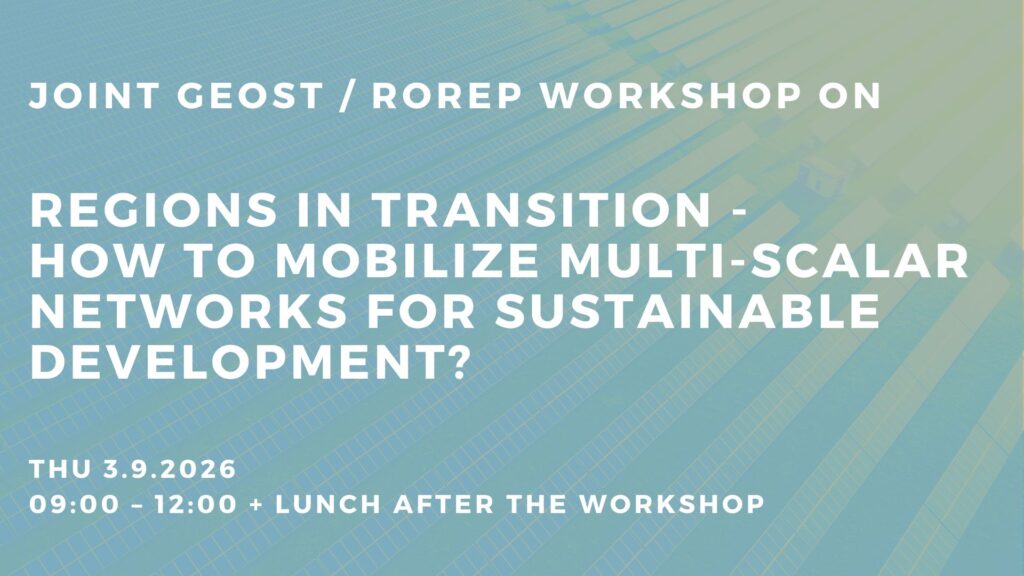
Join us after the IST Conference 2026 for a special workshop on: Regions in transition – How to mobilize multi-scalar networks for sustainable development?
Organized by the Sustainability Transitions Research Network (STRN) Thematic Group on the Geography of Sustainability Transitions (GeoST) and the Swiss Research Association for Regional Policy (ROREP – OEPR), this half-day workshop will bring together researchers and practitioners from transition studies, economic geography, and regional and innovation policy.
Together, we will explore a key question at the heart of GeoST research: How can regions leverage their position within multi-scalar networks to foster more sustainable development pathways?
The workshop will feature short input presentations, interactive discussions, and collective reflections on emerging research agendas and policy implications.
📅 Date: 3 September 2026
🕘 Time: 09:00–12:00, followed by lunch
📍 Location: ETH Zürich, ETZ Building
📋 Register here
The event is free of charge, and participation in the IST Conference is not required.
⚠️ Places are limited and will be allocated on a first-come, first-served basis.
GeoST Webinar series: The ‘global’ dimension of sustainability transitions
The fourth webinar series by the Geography of Sustainability Transitions thematic group aimed to foster interaction between scholars working on Global Production Networks (GPNs) and Global Value Chains (GVCs) and those engaged in the (geography of) sustainability transitions research.
The webinar series covered the following topics: a) a general introduction and panel discussion on potential trading zones, b) a session on actors, value chains, and governance, c) a session on developmental outcomes and just transitions, and d) a session on geopolitical turbulences and transitions.
To learn more, visit the webinar page.
View our entire archive here, and catch up on previous webinars on our Youtube channel.

Get involved
We welcome anyone interested in contributing to the group. Currently, Christian Binz (Eawag), Camilla Chlebna (Centre for Social Innovation, Vienna), Lars Coenen (Western Norway University of Applied Sciences), Huiwen Gong (University of Stavanger), Teis Hansen (University of Copenhagen), Christina Hoicka (University of Victoria), Jim Murphy (Clark University), Gesa Pflitsch (University of Natural Resources and Life Sciences, Vienna), Johan Miörner (Lund University), Markus Steen (SINTEF), and Bernhard Truffer (Eawag / Utrecht University) are managing the group’s activities.
If you are interested in contributing, please get in touch with .
News
58th STRN Newsletter
9 March 2026Call to host IST 2028
5 March 2026STRN survey on science-policy engagement and impact
18 February 2026